The Glass Curtain
Generated by openrouter/z-ai/glm-5-turbo · March 25, 2026
Behind the Iron Curtain, an empire of glass and brass hummed to life — producing millions of cameras, lenses, and optical instruments that equipped everyone from Red Army soldiers to curious schoolchildren. This is the story of the Soviet optical industry.
Origins (1930–1945)
The Soviet camera industry was born from both ambition and pragmatism. In 1930, the FED (ФЭД — Felix Dzerzhinsky Labour Commune, Feliks Dzerzhinsky Trudovoy Kommuna) in Kharkiv began producing the FED-1 — a near-exact copy of the Leica II — using tooling reportedly purchased from Germany. It was the Soviet Union's first mass-produced 35mm camera and the template for decades of rangefinder design to follow.
Two years later, in 1932, the Krasnogorsky Mekhanichesky Zavod (KMZ) (Красногорский механический завод) was established near Moscow. KMZ would go on to become the single most prolific camera manufacturer in Soviet history. Around the same time, LOMO (ЛОМО — Leningradskoye Optiko-Mekhanicheskoye Obyedinenie, Leningradskoye Optiko-Mekhanicheskoye Obyedinenie) opened its doors in Leningrad, specializing in both civilian and military optics.
World War II devastated Soviet manufacturing. Factories in Kharkiv and Leningrad were evacuated eastward to the Urals, where production continued under impossible conditions. After the war, captured German tooling and engineers accelerated Soviet efforts — the Zeiss factories in Jena and Dresden provided both literal blueprints and human capital that reshaped the industry.
The KMZ factory in Krasnogorsk, near Moscow — birthplace of the Zenit and Zorki cameras.
The Great Lens Heist: Operation Zeiss
The most dramatic chapter of Soviet optics procurement unfolded in the final days of World War II. As the Red Army swept into Germany, Soviet intelligence identified optical manufacturing as a priority target — on par with nuclear and rocket technology. Entire Zeiss factories in Jena were dismantled and shipped east. More significantly, hundreds of Zeiss engineers and optical scientists were forcibly relocated to the USSR as part of Operation Osoaviakhim (Осоавиахим) in October 1946, which saw over 2,000 German technical specialists transported to Soviet territory.
The Carl Zeiss works in Jena became a flashpoint in the early Cold War. The factory sat in the Soviet occupation zone but was claimed by both East and West Germany. Soviet authorities moved critical equipment and personnel to the USSR, while what remained became VEB Carl Zeiss Jena in East Germany. Meanwhile, the Western Allies helped Zeiss management re-establish in Oberkochen, West Germany — creating a corporate schism that mirrored the divided Germany itself. Soviet engineers who had studied Zeiss methods returned to KMZ, LOMO, and Arsenal and immediately set to work reproducing what they had learned, seeding decades of derivative designs.
The Golden Age of Soviet Optics (1945–1970)
The post-war decades represented the peak of Soviet camera production. From the late 1940s through the 1960s, the USSR built an optical complex that rivaled any nation's in sheer volume, if not always in refinement.
Key Manufacturers
| Manufacturer | Location | Known For |
|---|---|---|
| KMZ (КМЗ) | Krasnogorsk | Zorki rangefinders, Zenit SLRs, Horizont panoramic, Start |
| LOMO (ЛОМО) | Leningrad | LOMO Compact, Smena, Lubitel TLR, professional cine lenses |
| FED (ФЭД) | Kharkiv | FED rangefinders, FED-Zarya, Stereo FED |
| BelOMO (БелОМО) | Minsk | Agat, Vilia, Chaika compact cameras |
| ARSENAL (Арсенал) | Kyiv | Kiev rangefinders and SLRs (Contax/Yashica derivatives) |
| Valdai / LZOS (ЛЗОС) | Lytkarino | Lenses (Jupiter, Helios, Industar lines) |
Notable Camera Lines
- Zorki (Зоркий, 1948–1978) — KMZ's rangefinder line, initially a direct FED copy, evolved into the refined Zorki-4, one of the most produced rangefinders ever made.
- Zenit (Зенит, 1952–2000s) — SLR workhorse of the Soviet world. The Zenit-E alone sold an estimated 12 million units. Simple, rugged, and cheap.
- FED (ФЭД, 1934–1990) — The Leica-derived line that defined Soviet rangefinder photography for half a century.
- Kiev (Киев, 1947–1980s) — Built on captured Contax tooling from Kyiv's Arsenal factory. The Kiev rangefinders and later Kiev SLRs (based on Yashica designs) were considered among the finest Soviet cameras.
- Smena (Смена, 1953–1990s) — LOMO's budget line. Over 20 million produced. A plastic-bodied 35mm viewfinder camera that cost less than a roll of film in the West.
- Lubitel (Любитель, 1949–1980) — Mass-market twin-lens reflex. The Lubitel 166B is still in use today by lomography enthusiasts.
Manufacturer Profiles
KMZ — Krasnogorsky Mekhanichesky Zavod (Красногорский механический завод)
Founded: 1942, Krasnogorsk, Moscow Oblast | Key engineers: Nikolai Gavrilov (Николай Гаврилов), Zorki/Zenit lead designer
KMZ began life during the darkest days of WWII as an evacuation site for optical manufacturing displaced from Moscow and Leningrad. Located 20 km from the capital, the factory was close enough to the seat of power to enjoy priority access to materials and skilled labor — an advantage that would define its entire history.
The factory's first camera, the Zorki (1948), was a direct copy of the FED-1 (itself a Leica II copy). Within a few years, KMZ had diverged: the Zorki-3 (1951) introduced a combined rangefinder-viewfinder window, something the Leica III series also offered but which the FED line lacked. By the Zorki-4 (1955), KMZ had created arguably the best Soviet rangefinder — reliable, well-made, and equipped with slow shutter speeds down to 1 second.
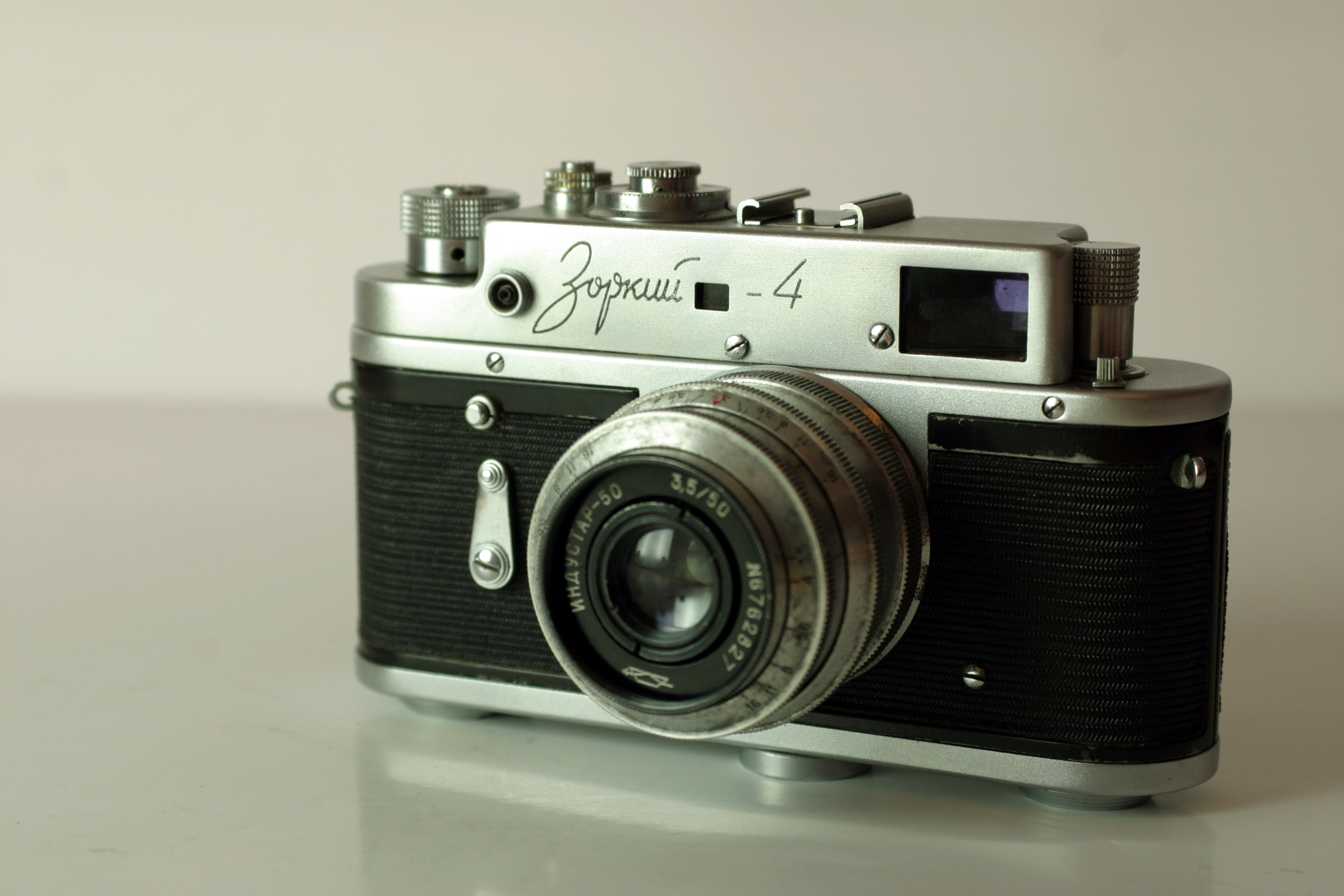
The Zorki-4, produced 1955–1973 — KMZ's flagship rangefinder and one of the most widely manufactured cameras in history.
In 1952, KMZ introduced the Zenit, their first SLR, by essentially grafting a reflex mirror housing onto a Zorki body. It was crude but effective. The Zenit-E (1965) refined the formula with an uncoupled selenium light meter and became the single most-produced SLR in history with an estimated 12 million units. The Zenit line continued in various forms until the 2000s, outlasting the USSR itself by over a decade.
KMZ also produced the Start (Старт, 1958), an ambitious professional SLR with interchangeable finders and a breech-lock mount — essentially a Soviet answer to the Exakta and Alpa. It was technically impressive but too complex for mass production and was discontinued after only a few years. The Horizont (Горизонт, 1967) panoramic camera and the Moskva (Москва) medium-format folders rounded out a remarkably diverse product catalog.
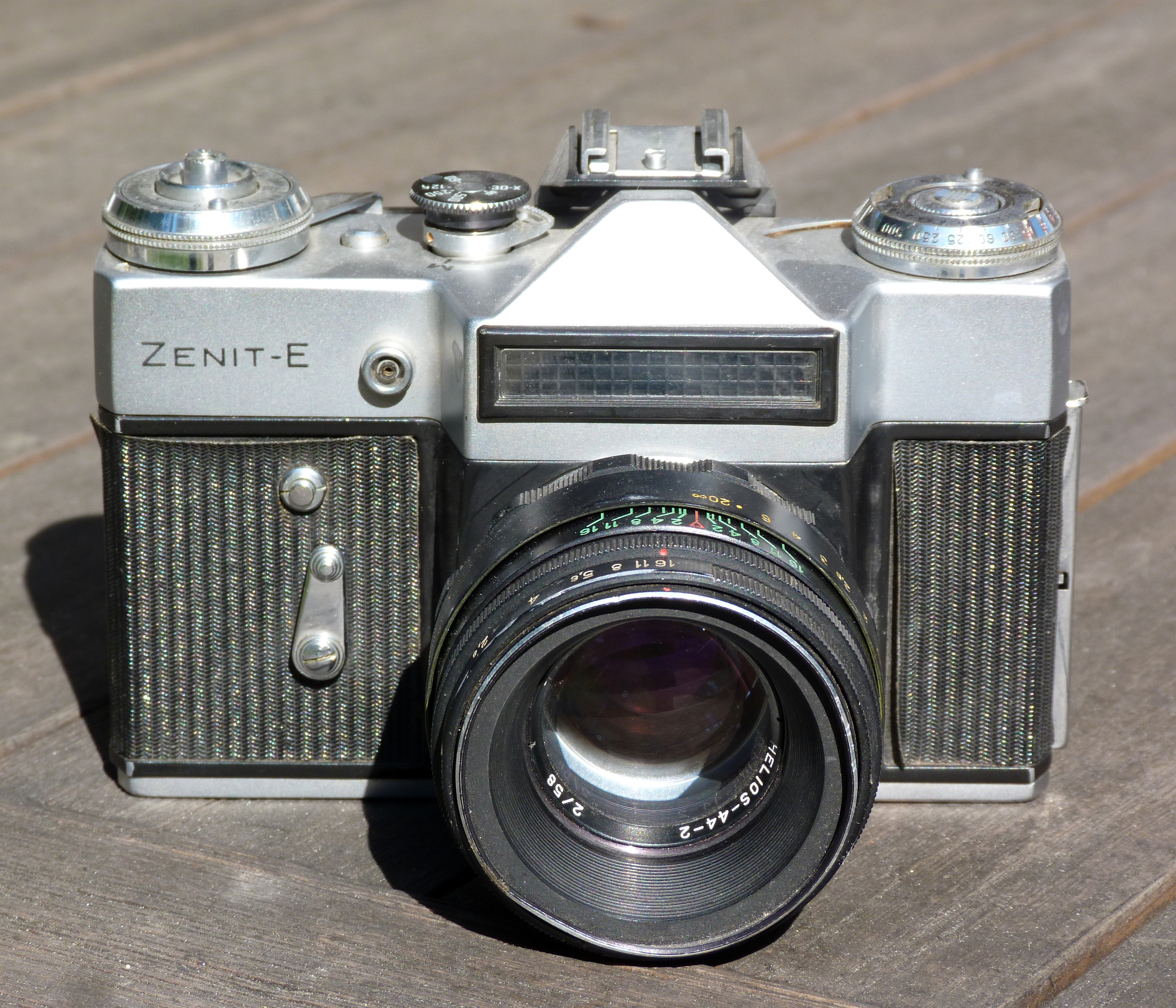
A Zenit-E fitted with the iconic Helios 44-2 lens — the combination that equipped millions of Soviet photographers.
Beyond consumer cameras, KMZ was a major military contractor. The factory produced periscopes, tank fire-control systems, aerial reconnaissance cameras, and satellite optics. This military work was classified and lucrative, subsidizing consumer camera production. Some military-grade optical coatings and design expertise eventually trickled down to consumer lenses, contributing to the surprisingly good performance of certain Helios and Jupiter variants.
Corporate rivalry: KMZ and FED maintained a tense competitive relationship throughout the Soviet era. Both produced rangefinders that competed for the same market. Central planners periodically attempted to rationalize production by assigning exclusive models to each factory, but both sides developed unlicensed variants of each other's designs. The rivalry was productive in its way — it drove incremental improvements that a monopoly would never have produced.
LOMO — Leningradskoye Optiko-Mekhanicheskoye Obyedinenie (Ленинградское оптико-механическое объединение)
Founded: 1914 (as Russian Optical and Mechanical Company), nationalized 1919, renamed LOMO 1962 | Location: Leningrad (St. Petersburg)
LOMO is the oldest and most versatile of the Soviet optical manufacturers. Its origins trace to a joint venture between French and Russian investors before WWI, making it one of the few Soviet factories with pre-revolutionary roots. The factory survived the brutal 900-day Siege of Leningrad (1941–1944) by converting entirely to military production — optical sights, binoculars, and artillery rangefinders — while much of the city starved around it. Workers labored in unheated workshops; an estimated 3,000 LOMO employees died during the siege.
Post-war, LOMO became the Soviet Union's premier optics house for precision instruments. While KMZ dominated mass-market cameras, LOMO built the equipment that the military and scientific establishment demanded:
- Space optics: LOMO produced cameras and lenses for the Sputnik program, Luna lunar probes, and Vostok/Voskhod manned missions. The LOMO-700 and specialized space cameras documented some of the most iconic images of the early Space Age.
- Medical optics: Endoscopes, surgical microscopes, and ophthalmic equipment — some of which were exported to Western Europe under the "Medicom" brand.
- Cinema lenses: LOMO's anamorphic cinema lenses (the LOMO Square Front series) became legendary in Hollywood decades later. Director Kathryn Bigelow used them on The Hurt Locker (2008), and they've appeared in numerous films seeking a distinctive vintage look.
- Mass-market cameras: The Smena line (over 20 million units), Lubitel TLRs, and the LOMO LC-A (1984) — a compact auto-exposure camera that would spawn a global cultural movement.
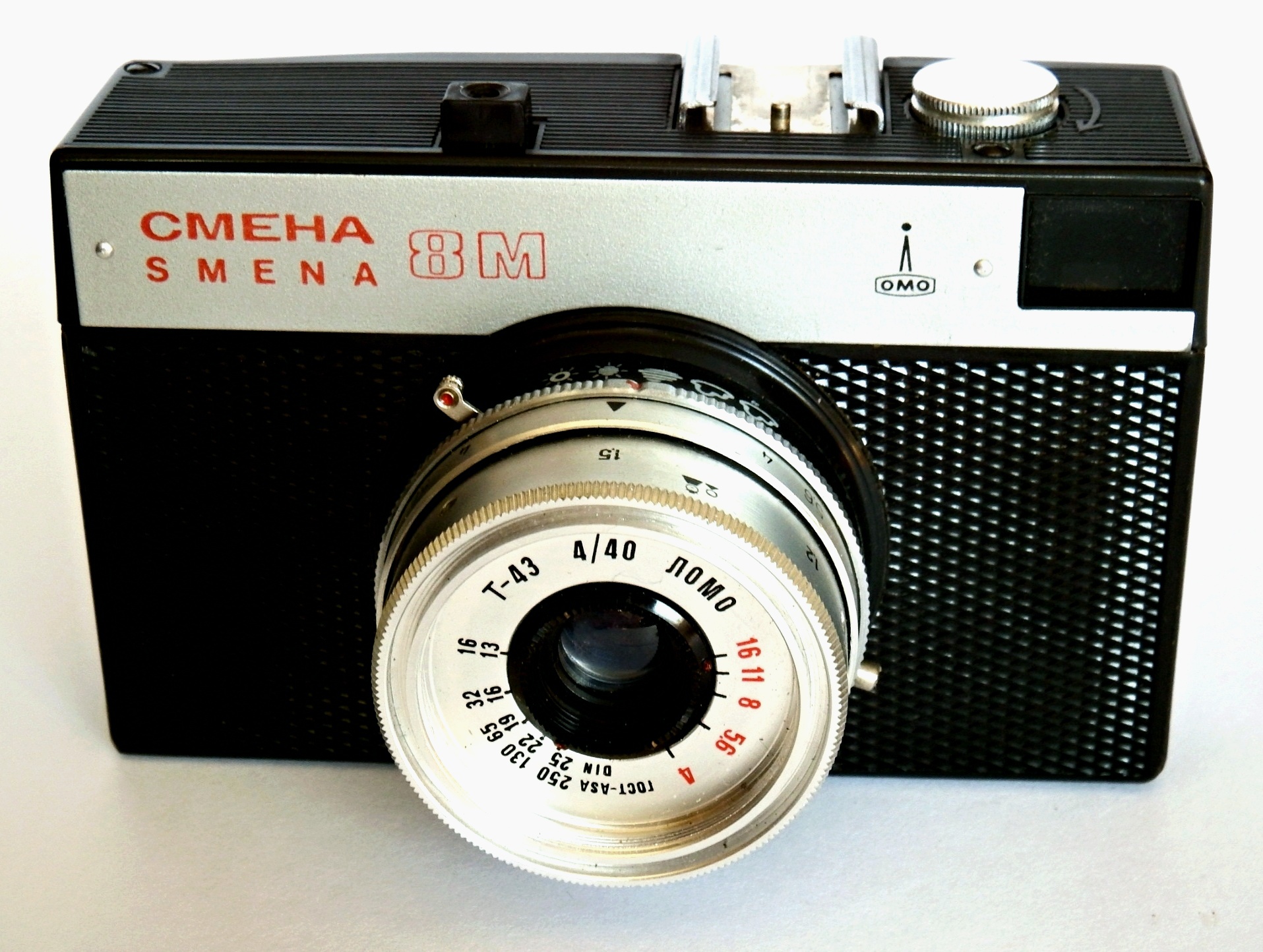
The Smena 8M — LOMO's ultra-budget 35mm camera, produced in the millions. Cost roughly the equivalent of two rolls of film.
FED — Felix Dzerzhinsky Labour Commune (ФЭД — Феликс Дзержинский)
Founded: 1932, Kharkiv, Ukrainian SSR | Named after: Felix Dzerzhinsky (Феликс Дзержинский), founder of the Soviet secret police (Cheka)
FED occupies a unique place in Soviet camera history as the industry's origin point. The commune was established as a rehabilitation project for orphaned youth — the factory school trained teenagers in precision manufacturing while producing cameras. This social mission gave FED a quasi-educational character that persisted for decades.
The FED-1 (1934) was a direct copy of the Leica II, reportedly made with tooling purchased through covert channels in Germany. The story goes that Soviet trade officials acquired the manufacturing equipment in the early 1930s, exploiting the economic chaos of the Weimar Republic. Whether the Leica Werk in Wetzlar knowingly sold the tooling or was tricked remains debated — Leica never publicly confirmed the transaction, and Soviet records from the period remain partially classified.
WWII was catastrophic for FED. Kharkiv fell to the Germans in October 1941, and the factory was evacuated to Berdsk in the Novosibirsk region. Production resumed in 1943 under extraordinary conditions — workers lived in barracks and manufactured military optics alongside cameras. The factory returned to Kharkiv after the city's liberation in 1943, but much of its pre-war equipment had been destroyed or looted.
The FED-2 (1955) was FED's most significant post-war design, featuring a new body with a non-removable back and combined rangefinder-viewfinder. The FED-3 and FED-4 added light meters (selenium and then CdS), and the FED-5 (1977) became the last FED rangefinder, produced until 1990. FED also made the Stereo FED (1950s) — a stereo camera that produced pairs of 24×24mm images on standard 35mm film — and the FED Micron, a half-frame camera that was remarkably compact for its era.
ARSENAL — Kyiv Arsenal Factory (Арсенал)
Founded: 1764 (as an imperial arsenal), converted to camera production 1947 | Location: Kyiv, Ukrainian SSR
The Arsenal factory is one of the oldest industrial enterprises in Eastern Europe, with origins as an imperial weapons works. Its conversion to camera production after WWII was enabled by the single most valuable piece of war booty in Soviet optics: the Contax tooling from Zeiss Ikon in Dresden.
The story of how the Contax tooling reached Kyiv is itself a tale of Cold War intrigue. As Soviet forces occupied Dresden in 1945, they discovered that Zeiss Ikon's Contax production equipment had been partially hidden by workers attempting to protect it from seizure. Soviet intelligence teams, led by officers from the military's technical intelligence directorate (GRTU), systematically located and packed the equipment — including precision dies, assembly jigs, and design documents — and shipped it to Kyiv. The Kiev-Contax connection was so direct that early Kiev rangefinders used some original Zeiss parts, and their shutters were virtually interchangeable with genuine Contax components.
The Kiev II/III/IV rangefinders (1947–1950s) were Contax copies so faithful that Western collectors sometimes cannot distinguish them from originals without serial number research. Later, Arsenal produced the Kiev-88 (1970s), a medium-format SLR clearly derived from the Hasselblad 1600F — another case where captured tooling or documentation enabled Soviet production. The Kiev-88 remains in use by photographers who appreciate its quirky character and modular design.
In the 1970s and 1980s, Arsenal partnered with Japan's Yashica (later Kyocera) to produce Kiev-branded SLRs using Yashica/Contax mount systems. The Kiev-19 and Kiev-20 were Contax-mount cameras that accepted Carl Zeiss lenses from West Germany — an ironic circularity given Arsenal's origins copying Zeiss designs.
BelOMO — Belarusian Optical and Mechanical Association (БелОМО — Белорусское оптико-механическое объединение)
Founded: 1957 (as Minsk Mechanical Works), consolidated as BelOMO 1971 | Location: Minsk, Byelorussian SSR
BelOMO was a relative latecomer to the Soviet camera industry, but became one of its most prolific manufacturers. The factory specialized in simple, inexpensive cameras for the mass market — products that prioritized affordability over optical quality. The Agat (Агат) half-frame camera, Vilia (Вилия), Chaika (Чайка) compact, and Siluet (Силуэт) electronic camera were all BelOMO products, typically sold for just a few rubles.
BelOMO's most significant contribution to photography history was probably the Vilia (Вилия, 1970s), a simple 35mm viewfinder camera with a 40mm f/4 triplet lens. Over 2 million were produced. It was the camera that many Soviet children received as their first — a gateway to photography for an entire generation.
After the dissolution of the USSR, BelOMO reinvented itself as a manufacturer of military and medical optics. Today the company still operates in Minsk, producing optical sights, medical equipment, and specialized optical instruments.
LZOS — Lytkarino Optical Glass Factory (ЛЗОС — Лыткаринский завод оптического стекла)
Founded: 1939, Lytkarino, Moscow Oblast | Specialty: Optical glass blanks, astronomical telescopes, camera lenses
LZOS was the Soviet Union's primary manufacturer of optical glass — the raw material from which all other factories ground their lenses. Control over glass formulation gave LZOS enormous influence in the Soviet optical ecosystem. The factory also produced finished camera lenses, most notably the Helios and Jupiter lines that equipped millions of Soviet cameras.
Perhaps LZOS's most impressive achievement was non-photographic: the factory produced the primary mirror for the BTA-6 (БТА-6 — Большой телескоп альт-азимутальный, Bolshoy Teleskop Alt-azimutalny) at the Special Astrophysical Observatory in the Caucasus Mountains. Completed in 1975, the BTA-6 had a 6-meter mirror — the largest in the world at the time — ground and polished entirely by LZOS. This was a feat of optical manufacturing that demonstrated the factory's capabilities exceeded anything required for consumer photography.
In the post-Soviet era, LZOS was partially privatized and now operates as JSC LZOS. It continues to produce astronomical optics and precision glass, and its mirrors are used in major observatories worldwide.
The Lens Dynasty
If Soviet camera bodies were sometimes rough, their lenses were often extraordinary. Soviet optical design, informed by both German traditions and native innovation, produced some of the finest glass of the 20th century — particularly at the price point.
Iconic Soviet Lenses — Specifications
| Lens | Focal Length | Max Aperture | Mount | Design Origin | Notes |
|---|---|---|---|---|---|
| Helios 44-2 (Гелиос) | 58mm | f/2 | M42 | Zeiss Biotar 58/2 | Most produced Soviet lens; legendary swirly bokeh |
| Jupiter-9 (Юпитер) | 85mm | f/2 | M39/M42 | Zeiss Sonnar 85/2 | Superb portrait telephoto; still used by filmmakers |
| Jupiter-3 (Юпитер) | 50mm | f/1.5 | M39 (LTM) | Zeiss Sonnar 50/1.5 | One of the fastest Soviet lenses; beautiful rendering |
| Jupiter-8 (Юпитер) | 50mm | f/2 | M39 (LTM) | Zeiss Sonnar 50/2 | Standard rangefinder lens; sharp and compact |
| Industar-50 (Индустар) | 50mm | f/3.5 | M39 (LTM) | Zeiss Tessar | Collapsible; shipped with millions of cameras |
| Industar-61 (Индустар) | 52mm | f/2.8 | M42 | Tessar derivative | Lanthanum glass for superior correction |
| Tair-11 (Таир) | 133mm | f/2.8 | M42 | Soviet original | Preset aperture; massive focus ring; razor sharp |
| Tair-3 (Таир) | 300mm | f/4.5 | M42 | Soviet original | Legendary telephoto; enormous but excellent |
| Mir-1 (Мир) | 37mm | f/2.8 | M42 | Flektogon-type | Wide-angle; close-focus to 0.24m |
| Helios-40 (Гелиос) | 85mm | f/1.5 | M39/M42 | Biotar derivative | Ultra-fast; rare and sought after today |
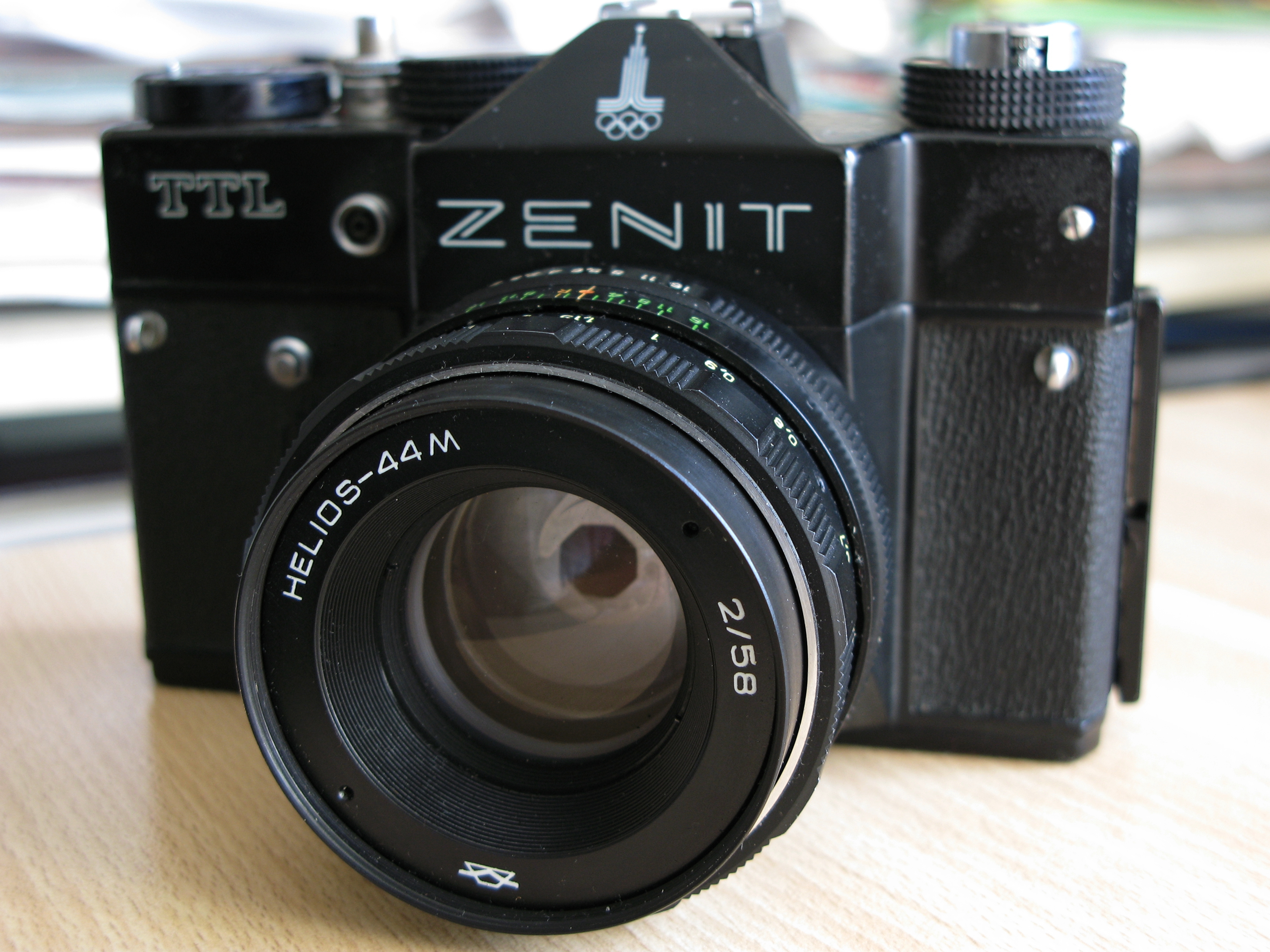
Zenit TTL — one of the later M42-mount Zenits, showing the mature evolution of the SLR line.
The Helios 44-2 deserves special attention. Based on the Zeiss Biotar 58mm f/2 — a six-element double-Gauss design — the Helios 44 went through at least 15 major variants during its production life. Early versions used uncoated glass; later ones received multi-coating. The 44-2 variant (the most common) is distinguished by its 13-blade aperture and its characteristic "swirly bokeh" — a swirling background blur that appears when shooting wide open with a non-planar background. This effect, considered a flaw in optical design, became enormously popular in the 2010s digital filmmaking scene, driving demand (and prices) for the humble Helios 44-2 on eBay and similar platforms.
The Jupiter-9 (85mm f/2) was the Soviet Union's premier portrait lens. Based on the pre-war Carl Zeiss Sonnar, it was produced in both M39 rangefinder and M42 SLR mounts. Its rendering is creamy and flattering, with smooth bokeh and excellent micro-contrast. Directors like Gareth Edwards reportedly used Jupiter-9s on early digital projects. Today, a good copy commands $150–300 on the used market — a fraction of the price of a contemporary equivalent.
The Industar-61 series represented genuine Soviet optical innovation. By incorporating lanthanum oxide into the glass (a rare earth element), LZOS achieved higher refractive indices with lower dispersion — allowing simpler lens designs with better correction. The Industar-61L/D (52mm f/2.8 for Zenit SLRs) is one of the sharpest Soviet lenses ever made, outperforming many Western Tessar-type lenses in resolution tests.
Timeline of Key Products
Optics in the Cosmos
The Soviet space program relied heavily on domestic optical manufacturing, and the results were remarkable. LOMO, LZOS, and other factories produced the optical systems that allowed humanity to see beyond Earth for the first time:
- Sputnik (1957): The first artificial satellite carried no camera, but its optical tracking systems and ground-based observation equipment were Soviet-made. LOMO produced tracking optics for the observation network.
- Luna 3 (1959): This probe captured the first photographs of the Moon's far side — using a Soviet-designed camera system with film that was developed onboard, scanned, and transmitted back to Earth. The optical system was built by LOMO engineers working under extraordinary constraints (weight, radiation, temperature extremes).
- Vostok program (1961–63): Yuri Gagarin's capsule and subsequent Vostok flights carried LOMO-built cameras for Earth observation. The cameras had to be operable by cosmonauts wearing pressure suits and gloves.
- Luna 9 (1966): First soft landing on the Moon; transmitted panoramic photographs using a scanning camera system with Soviet optics.
- Zenit reconnaissance satellites (1960s–80s): Not to be confused with the KMZ camera, the Zenit satellite series used high-resolution film-return cameras built by LOMO and defense optics plants. These satellites returned film capsules from orbit — the same basic principle as the American Corona program.
- Almaz space station (1970s): The military Almaz program included a sophisticated optical reconnaissance module with a massive telescope/camera system, reportedly using mirrors ground by LZOS. The station's Agat-1 camera achieved ground resolution estimated at 1–2 meters — remarkable for film-based orbital photography.
Clone Culture and Technical Reality
The Soviet approach to camera design was, bluntly, one of strategic copying. This wasn't theft in the cruder sense — it was state policy. Leica, Zeiss, Contax, Exakta, Nikon, and Yashica designs were all reproduced, sometimes with slight modifications, sometimes faithfully down to the engravings.
But calling the entire output mere copies misses the nuance. Over time, Soviet engineers adapted and sometimes improved upon their German and Japanese starting points. The Helios 44 developed bokeh characteristics that the original Biotar never had. The Zenit SLR line diverged significantly from its Exakta ancestors. The Kiev-88 (a Hasselblad 1600F derivative) became its own platform with unique accessories and modifications.
Quality control was the Achilles' heel. A good Soviet lens could rival anything from Germany or Japan. A bad one — and there were many — could arrive with decentered elements, rough focusing, or oil on the aperture blades. The inconsistency was legendary: buying Soviet gear meant accepting the lottery.
The Espionage Dimension
Soviet procurement of Western optical technology wasn't limited to post-war seizures. Throughout the Cold War, Soviet intelligence actively targeted Western optical manufacturers. The KGB's Directorate T (scientific and technical intelligence) maintained dedicated officers who cultivated sources at companies like Carl Zeiss, Nikon, Canon, and Leica. Technical manuals, coating formulas, and prototype specifications were all considered high-value intelligence targets.
A well-known anecdote involves a Soviet trade delegation visiting Japan in the 1960s. During a factory tour at Nikon, a delegate reportedly managed to memorize critical dimensions from a prototype lens assembly before the tour guide realized what was happening. Within two years, a suspiciously similar Soviet lens appeared — though proving direct copying from such encounters is difficult. Nikon was reportedly so concerned about industrial espionage that it restricted factory access for Soviet visitors for years afterward.
Another story concerns the Soviet effort to replicate Japanese multi-coating technology in the 1970s. Japanese multi-coating (pioneered by Asahi Pentax in 1971) dramatically reduced flare and improved contrast. Soviet intelligence reportedly obtained coating chemical formulas through Eastern Bloc intermediaries who had access to Zeiss Jena's research. The result was the MC (multi-coated) designation on late Soviet lenses — the Industar-61 MC and Helios 44M being notable examples.
How the West Discovered Soviet Gear
For most of the Cold War, Soviet cameras were virtually unknown in the West. Iron Curtain trade restrictions, combined with Soviet disinterest in consumer exports, kept them out of Western camera shops. A few reached the West through diplomatic pouches, military intelligence, or the rare Eastern Bloc tourist with a camera to sell.
The breakthrough came in the 1970s, when Soviet state trading companies began exporting cameras through intermediaries in Finland, East Germany, and Austria. Soviet cameras appeared in European camera shops at absurdly low prices — a Zenit-E with Helios lens for £20–30 when a comparable Western SLR cost ten times that. British photography magazines published reviews that were honestly ambivalent: the build quality was rough, the light meter inaccurate, but the lenses were surprisingly good and the price was unbeatable.
The 1980s saw Soviet cameras enter the North American market through importers like SoCal (Southern California) and later through mail-order catalogs. Enthusiast publications like Shutterbug regularly featured Soviet gear. The pitch was always the same: German-quality glass at Soviet prices. The reality was more nuanced — quality varied wildly — but the bargains were genuine.
The 1990s post-Soviet collapse created a flood of Soviet cameras and lenses on the Western market. Former state stores emptied their inventory. Military surplus auctions offered special-purpose equipment. And with the rise of internet marketplaces in the late 1990s, Soviet optics became a global commodity. A Helios 44-2 that cost the equivalent of $15 in a Moscow store in 1985 could now be shipped to any address in the world for $20–30 plus shipping.
Optics in the Cold War
Civilian camera production was only part of the story. The same factories that produced Zenits and Helios lenses also built:
- Military periscopes, tank sights, and fire-control optics
- Satellite and space-program cameras (LOMO produced optics for Sputnik and Luna missions)
- Microscopes and medical endoscopes
- Photographic reconnaissance systems
- Copy machines and phototypesetting equipment
The dual-use nature of Soviet optics meant that the industry received steady state investment regardless of consumer demand. Cameras were, in a sense, a byproduct of military readiness — which is why the USSR could afford to sell them at prices no Western manufacturer could match.
Decline and Collapse (1970–1991)
By the 1970s, Japanese camera makers had moved decisively into autofocus, electronic shutters, and multi-coated lens systems. The Soviet industry, hobbled by outdated tooling, bureaucratic inertia, and isolation from global supply chains, fell further and further behind. Consumer electronics imports from Japan were restricted, so Soviet citizens had no alternative — but the quality gap was obvious to anyone who saw both.
The perestroika years (late 1980s) brought partial openness. Soviet cameras began appearing in Western markets, where they were sold as curiosities and budget options. But by the time the USSR dissolved in 1991, the industry was a shadow of its former self.
Legacy and Collectibility
Today, Soviet cameras occupy a unique niche in photography history:
- Accessible entry into film photography — A working Zenit-E with a Helios 44-2 still costs under $50–80. For the price of a roll of film, you can own a piece of optical history.
- Lomography movement — The LOMO LC-A (1984), a compact auto-exposure camera, spawned the global "lomography" phenomenon in the 1990s, celebrating lo-fi, experimental photography. The movement persists today.
- Modern lens adapters — M42-mount Soviet lenses (Helios, Jupiter, Tair, Mir) adapt easily to virtually any mirrorless camera. Their character rendering has made them popular with digital filmmakers and portrait photographers seeking an analog look.
- Collector interest — Rare variants command serious prices: early FED-NKVD models, Kiev rangefinders with Contax markings, prototype Zenits, and military-issue equipment. Common models remain cheap but historically significant.
- Cultural artifacts — Soviet cameras are tangible objects from a vanished system. They embody the contradictions of the USSR: genuine engineering talent constrained by political and economic dysfunction, producing brilliant work alongside mediocrity.
"Every Soviet citizen held a camera. Not because they were photographers, but because the state made it impossible not to be."
The Soviet optical industry produced an estimated 50 million cameras over its 60-year history. They documented weddings in Tashkent and winters in Norilsk, factory floors in Magnitogorsk and vacations in Sochi. They were imperfect, inconsistent, and sometimes magnificent. They were, in every sense, a mirror of the system that made them.
Image Attributions
- KMZ factory photo: ТД. КМЗ — Public domain. Source: Wikimedia Commons
- Zorki-4 camera: RRT877 — CC0 (Public Domain Dedication). Source: Wikimedia Commons
- Zenit-E with Helios 44-2: Elekes Andor — CC BY-SA 4.0. Source: Wikimedia Commons
- Zenit TTL: Petar Milošević — CC BY-SA 4.0. Source: Wikimedia Commons
- Smena 8M: Jaroslav A. Polák — CC BY 3.0. Source: Wikimedia Commons


